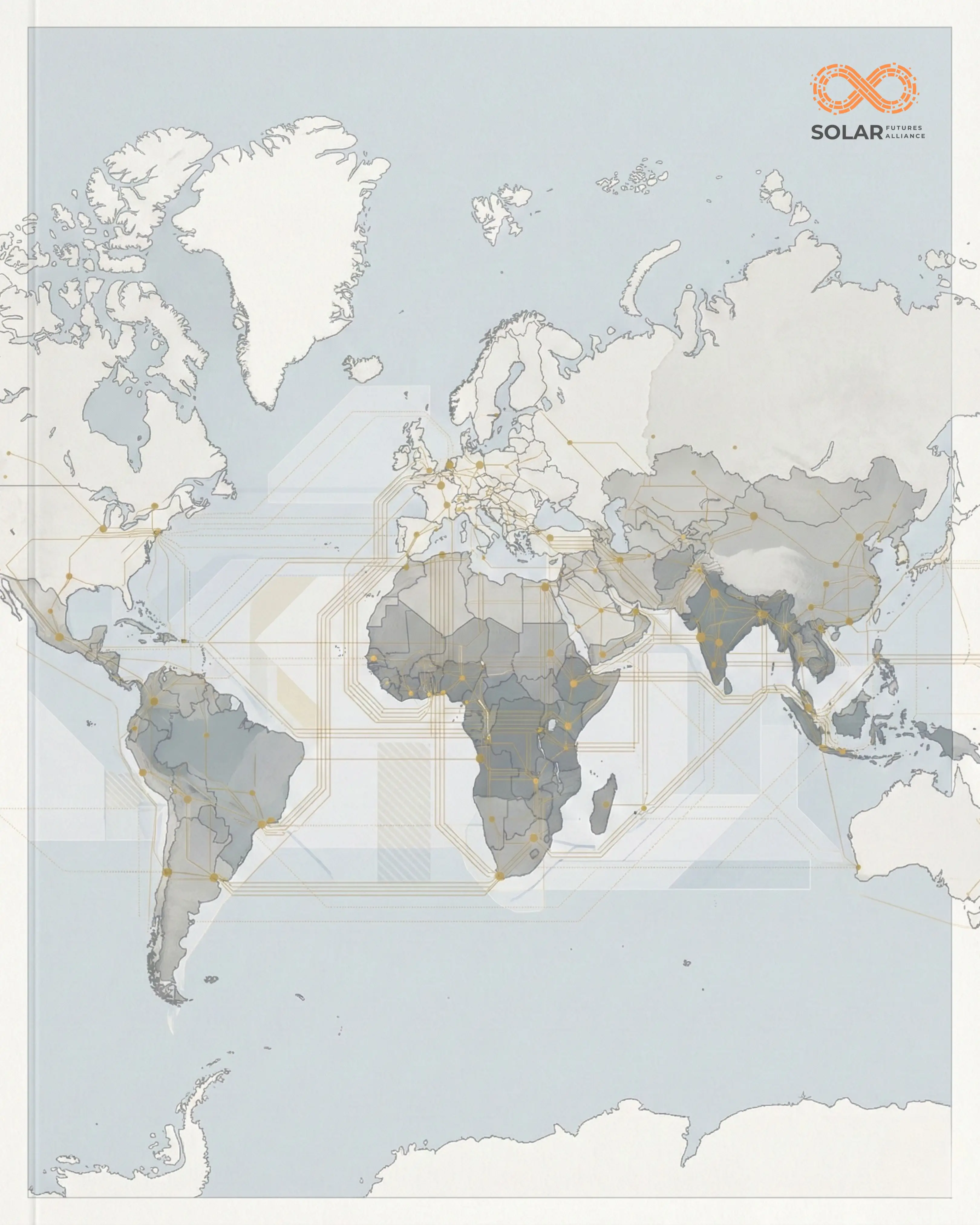
Solar Futures Alliance envisions a future in which clean, affordable, and reliable solar energy is a cornerstone of development across the Global South and beyond. In this future, solar power drives environmental sustainability, supports broad-based economic prosperity, and strengthens energy sovereignty for nations and communities alike, advancing equitable development pathways and a more resilient global energy system. We view solar energy as a strategic enabler of integrated energy, climate, and development policies that underpin long-term economic resilience.
Our mission
Our mission is to accelerate the global transition to solar energy by advancing innovation in solar technologies, shaping enabling and inclusive energy policies, and strengthening institutional and community capacity. With a deliberate focus on the Global South, we address the intersection of energy access, development priorities, and climate vulnerability, working to bridge energy gaps, support sustainable economic growth, and enhance climate resilience. Through research, policy engagement, and strategic collaboration, we aim to ensure that the solar transition delivers equitable outcomes and contributes to long-term development and energy security.
Our Journey Begins
Solar Futures Alliance was established in response to the growing global imperative to accelerate climate action while advancing equitable development. Conceived as an international organisation, the Alliance is dedicated to advancing solar energy as a central pillar of sustainable growth, energy sovereignty, and climate resilience, particularly across the Global South.
From the outset, our work has been guided by a shared conviction: that solar energy is not only a technological solution, but a strategic opportunity to reshape energy systems in ways that are inclusive, resilient, and development-oriented. Solar Futures Alliance operates at the intersection of policy, markets, innovation, and capacity, bringing together governments, industry, finance, academia, civil society, and international institutions.
A defining strength of the Alliance is its international Advisory Board, comprising distinguished policymakers, industry leaders, practitioners, researchers, and academics. This collective expertise informs our strategic direction, grounding our work in global best practices while remaining responsive to regional and national contexts.
Since its inception, Solar Futures Alliance has emerged as a trusted convening and thought leadership platform, contributing to dialogue at major global and regional forums including COP processes, Climate Weeks, G20-related engagements and engaging at national and local levels to translate global ambition into practical, context-specific action.
At the core of our journey lies a commitment to partnership. We believe the scale and complexity of the energy transition demand collaboration across borders and sectors. By fostering long-term partnerships and enabling collective action, Solar Futures Alliance is working to help shape a future in which solar energy underpins sustainable development, economic opportunity, and climate resilience.
Our Approach
Solar Futures Alliance advances the solar-led energy transition across the Global South by translating policy ambition into practical, scalable action. We support governments, institutions, and market actors in navigating the intersection of energy access, development priorities, and climate resilience.
Our work focuses on strengthening policy and regulatory frameworks through research, policy dialogue, and strategic advisory, enabling evidence-based decision-making that places solar energy at the center of sustainable development strategies across diverse national and regional contexts.
Knowledge exchange and capacity-building are central to our approach. Through workshops, training programs, and expert dialogues, we equip stakeholders with the technical, institutional, and leadership capabilities required to accelerate solar adoption at scale.
Collaboration underpins all our efforts. By convening policymakers, industry leaders, financial institutions, researchers, and civil society, Solar Futures Alliance fosters partnerships that drive innovation and implementation.
Through this integrated approach, we work to ensure that the solar transition delivers measurable outcomes, strengthening energy systems, advancing inclusive growth, and enhancing climate resilience across the Global South.
SFA ADVISORY BOARD
Amitabh Ranjan
Amitabh Ranjan holds a B.Tech. in Petroleum Engineering from IIT (ISM) Dhanbad and an MBA in HR. He has over a quarter-century of experience in diverse fields, including Civil Services. He has extensive experience in grassroots governance and public administration, including managing various government schemes, financial management, general administration, and capacity building. ...
An alumnus of the Near East South Asia Center for Strategic Studies (NESA) at the National Defense University, Washington, DC, he has traveled extensively across the globe for academic engagements, visiting countries such as the USA, France, Germany, Belgium, Switzerland, the Netherlands, Australia, New Zealand, Vietnam, Thailand, Bangladesh, and Bhutan.
Currently, he serves as the Registrar in a leadership position at the Indian Institute of Public Administration (IIPA), New Delhi, one of the premier training and research institutions of the Government of India, dedicated to capacity building for civil servants across various fields. The Hon'ble Vice President of India is the President of IIPA, while the Hon'ble Union Minister of State in charge of the Ministry of Personnel, Public Grievances & Pensions serves as the Chairman of its Governing Board.
Previously, he worked as Deputy Director at the STQC Directorate, Ministry of Electronics & Information Technology (MeitY), Government of India, and as a Provincial Civil Services (PCS) officer in the Government of Uttar Pradesh. During his tenure, he oversaw the computerization of the Transport Department of Uttar Pradesh and is widely credited for the successful implementation of the pilot projects "Vahan" (for vehicle registration) and "Sarathi" (for driving licenses), both of which are now fully operational in the state.
As a petroleum engineer with significant experience in the transport sector, he has developed a keen interest in the energy domain, particularly in renewable energy areas such as solar energy, energy transition, net-zero initiatives, and issues related to the environment and climate change.
Ann Margret Francisco
Ms. Ann Margret Francisco assumes the role of Philippine Country Manager at the Global Wind Energy Council (GWEC), where she identifies and supports key policy and market workstreams to critically shape the nation's wind energy sector.
With a 17-year track record in the Philippine power industry, Ms. Francisco has been at the forefront of developing and overseeing renewable energy (RE) projects for both public and private entities. ...She began her career in the public sector in 2006, making significant contributions as one of the pioneering energy traders for the Power Sector Assets and Liabilities Management Corporation. Transitioning seamlessly to the private sector, she continued managing power asset portfolios before shifting her professional focus in 2016 toward renewable energy projects and business development, aligning with the country's ambitious RE targets.
Prior to joining GWEC, Ms. Francisco served as a market consultant for smaller RE firms, providing valuable advice on navigating the industry's regulatory and commercial frameworks.
Ms. Francisco's dual experience in both government and private sectors has equipped her with a comprehensive understanding of the complexities within the energy landscape.
At GWEC, she is currently supporting OFW stakeholders through workshops, policy papers, and focused group discussions (FGDs).
Aurora Audino
Aurora is a climate and nature expert, currently working with UNDP on biodiversity finance in Istanbul. She previously supported the European Commission in Brussels, focusing on climate policy and sustainable finance, where she contributed to key EU climate policy initiatives. Aurora has worked across public and private sectors on climate strategies, sustainability and environmental compliance, ... including for the European Parliament and the Edison Group. A committed advocate for climate action,
Aurora has participated in the last 4 UN Climate Conferences and has spoken and moderated international high-level events. She was recognised as a European Climate Pact Ambassador and MTE Climate Ambassador (a program of the World Bank Group's Youth-to-Youth community). She has also amplified youth voices in national and international forums, including Youth4Climate in New York and the G7 Youth. Aurora also leads initiatives and training on climate and renewable energy action, as Italy-IRENA Peer Educator, and contributes to fostering intergenerational dialogues.
Benson Ireri
Benson Ireri is a recognized leader in energy access and climate finance, with extensive experience in advancing clean energy deployment, policy advocacy, and strategic partnerships across Africa.
Benson is currently serving as Head of the Clean Cooking Delivery Unit at Clean Cooking Alliance (CCA), Kenya.
Previously, as the Africa Lead for Energy Access at the World Resources Institute (WRI), Benson played a pivotal role in shaping inclusive energy transitions by leveraging data-driven solutions, innovative financing mechanisms, and policy interventions to expand access to renewable energy.
... With a deep commitment to energy equity and sustainable development, Benson has spearheaded impactful initiatives that bridge the gap between global climate finance and local clean energy investments, particularly in emerging economies. His expertise spans energy planning, climate finance mobilization, and fostering multi-stakeholder collaborations, making him a key advocate for scaling solar adoption and ensuring a just energy transition in Africa and beyond.
Benson brings a wealth of experience in integrated energy solutions, policy engagement, and investment mobilization to accelerate renewable energy adoption, particularly in the Global South.
Dr. Jochen Rentscha
Dr. Rentsch serves as the Head of Technology Transfer at the Fraunhofer Institute for Solar Energy Systems (ISE), Germany.
Dr. Rentsch received his Ph.D. degree in physics in 2005 from the Albert-Ludwigs University of Freiburg, Germany. He studied physics at the Technical University of Braunschweig and the University of Sussex (Brighton, UK) and obtained his diploma degree in 2002.
...
His current work focuses on the acquisition and management of industrial-funded projects, licensing of R&D results, and the transfer of processes and cell structures in the PV industry. Additionally, he provides consultancy and auditing of PV manufacturing facilities worldwide, bringing extensive expertise to the advancement of solar energy technologies.
Dr. Kapil Narula
Dr. Kapil Narula is a Senior Analyst at the Climate Champions Team in Dubai, UAE, where he plays a pivotal role in catalyzing international cooperation for ambitious climate action. With over two decades of versatile experience spanning international organizations, government, think tanks, and academia, his work focuses on the clean energy transition, climate change, and maritime sustainability.
...
He has authored or edited seven books and over 100 articles and papers, contributing significantly to the discourse on sustainability. His previous roles include Economic Affairs Officer at the United Nations, Advisor (Energy) at NITI Aayog, and lecturer at the University of Geneva, alongside his service in the Government of India. Kapil holds an interdisciplinary PhD in economics, a master's degree in engineering, and a certification in sustainability and climate risk.
Dr. Kavita Rai
Dr. Kavita Rai is a Senior Programme Officer at the International Renewable Energy Agency (IRENA). She is a renewable energy and development professional with 30 years international experience designing and delivering a range of programs including capacity development, entrepreneurship development, financing, gender and policy. Kavita holds a PhD in Development Studies from the University of Bonn, Germany.... At IRENA, she is leading the energy access and cross-sectoral work in the Country Engagement and Partnership Division.
Laurence Pollier
With over three decades at the forefront of international climate policy, her unwavering commitment to sustainability and multilateralism has defined her journey.
Her role as Strategic Advisor and Team Lead for the coordination of the negotiations under the Paris Agreement,the Kyoto Protocol, and their Subsidiary Body for Implementation (SBI) is underpinned by a dedication to fostering inclusive dialogue and actionable policy guidance. ... Her in-depth and unique understanding of climate change multilateral processes has been instrumental in navigating the complex landscape of international climate diplomacy.
Keen to share her experience and insights as well as empower young professionals, she offers mentorship and guidance on the multilateral processes. Passionate about innovation and efficiency, she strives to do things differently when it means doing things better.
Miguel Lotero Robledo
Miguel Lotero Robledo is a dynamic energy sector leader with a strong foundation in public policy, markets, and regulation. He holds a Law degree from Universidad EAFIT and a postgraduate specialization in Public Management and Administrative Institutions from Universidad de Los Andes. He also earned a Master's in Public Law (LLM), with a focus on Administrative Management, from Universidad de Los Andes and a Master's in Public Administration (MPA) from the London School of Economics and Political Science (LSE), where he studied as a Colfuturo scholar.
...
Miguel's career has been defined by his expertise in designing and implementing transformative public policies for energy and natural resources. Between 2018 and 2022, he played a pivotal role in the Colombian government, first as an advisor to the Minister of Mines and Energy and later as Vice Minister of Energy. During his tenure, Miguel spearheaded groundbreaking initiatives that laid the foundation for Colombia's energy transition, including renewable energy financing, offshore wind development, and hydrogen regulation. His leadership also extended to creating a sustainable mobility roadmap and revitalizing the oil and gas sector. Notably, his efforts enabled over 100,000 families in remote areas of Colombia to gain energy access through innovative public-private financing mechanisms for expanding the gas grid and installing solar PV solutions.
Miguel is a partner at Lotero Zuluaga Abogados, where he leads the energy and natural resources practice. He also advises on markets and regulation as an expert consultant at OWC Ltd. and teaches Energy Markets and Regulation at EAFIT University. In addition to his professional roles, he serves on several energy sector boards of directors, contributing to strategic decisions that shape the industry's future.
Fluent in Spanish and English, Miguel brings a global perspective to his work and demonstrates a deep commitment to fostering sustainable and equitable energy solutions.
Nathalie Hemeleers
Nathalie Hemeleers is a seasoned expert in energy and climate policies, with over a decade of experience driving impactful initiatives at both the EU and national (Belgian) levels. Throughout her career, she has been a strong advocate for accelerating the energy transition and transforming economies into sustainable, clean, and circular systems built on principles of social justice.
Currently serving as the Director for EU Affairs at the Solar Impulse Foundation, ...Nathalie focuses on promoting the modernization of production and consumption processes through the adoption of clean and efficient solutions. Her expertise in policy, sustainability, and strategic advocacy is invaluable in advancing global clean energy goals.
Dr. Ricardo Raineri
Dr. Ricardo Raineri is an accomplished energy economist with a distinguished career spanning energy policy, macroeconomics, and industrial organization. Widely recognized as a leading authority in the energy sector, he brings extensive advisory and leadership experience across the public and private sectors, multilateral organizations, and financial institutions. His expertise encompasses market and regulatory design, technological innovation, finance, and governance, making him an invaluable asset to SFA....
Dr. Raineri's contributions to the energy sector have been remarkable, with pivotal roles such as Energy Minister of Chile, Board Chairperson for State-Owned Oil Enterprises, and Representative at the World Bank Group. As Energy Minister, he provided strategic oversight of key energy institutions,including the National Energy Commission (CNE) and the Chilean Nuclear Energy Commission (CCHEN). He spearheaded transformative energy policies in electricity, renewables, energy efficiency, and environmental sustainability, establishing initiatives like the Chilean Energy Efficiency Agency (AChEE). His policy frameworks laid the foundation for sustainable development and long-term energy security in Chile.
He also served as President of the International Association for Energy Economics (IAEE), promoting best practices in energy security and sustainability while leading global discussions on energy and economic development. During his tenure as Alternate Executive Director at the World Bank Group, he represented six South American countries, influencing development agendas and advocating for sustainable growth aligned with global financial stability.
Dr. Raineri's advisory expertise includes working with governments, development banks, and major corporations across Latin America and beyond, including organizations like the IEA, the CAF Development Bank of Latin America, and multinational firms such as Endesa S.A. and Credit Suisse. He was instrumental in driving a $265 million clean technology research institute proposal in Chile, supporting advancements in solar energy, lithium development, and sustainable mining.
A dedicated academic, Dr. Raineri is a Professor in the Department of Industrial and Systems Engineering at Pontificia Universidad Católica de Chile. His research contributions and publications have shaped thought leadership in energy economics, technological innovation, and policy frameworks.
Saad Siddique
Saad Siddique is a multidisciplinary energy economist and analyst at the Environmental Law & Policy Center (ELPC) in Chicago, where he provides expert testimony in utility rate cases and regulatory proceedings. His work focuses on engineering and economic evaluations of grid planning, decarbonization technologies, and energy policies, with expertise in demand response, energy efficiency, and renewable energy integration. Siddique combines techno-economic analysis and ...data-driven modeling to advance equitable transitions toward affordable, resilient, and climate-friendly energy systems, balancing climate action with community needs, particularly for vulnerable populations.
Before joining ELPC, Siddique contributed to U.S. economy-wide decarbonization strategies through GTI Energy's Low-Carbon Resources Initiative, where he led hydrogen and carbon infrastructure analysis. His diverse career includes roles in emissions regulation at the Texas Commission on Environmental Quality, analytics at Stanford University, economic modeling at the Texas Bureau of Economic Geology, and solar farm implementation at Robert Bosch Diesel Systems. This comprehensive experience informs his systems-level approach to energy transitions. Siddique holds an MS in Energy & Earth Resources from the University of Texas at Austin, complemented by Harvard Business School credentials in economics and analytics, and a bachelor's degree in mechanical engineering from Visvesvaraya Technological University.
Siddique's global leadership is evident in his roles as former Managing Editor of the Journal of Petroleum Resources Economics and coordinator of student chapters across four continents for the Society of Petroleum Resources Economists. His achievements include the Repsol STEM Innovation Award for energy sector leadership, the J.N. Tata Scholarship for academic excellence, and membership in Al Gore's Climate Reality Leadership Corps. He co-founded the SOUL Education Non-Profit Trust and mentors through organizations like the Switch Energy Alliance, blending technical expertise with community engagement.
Beyond his professional work, Siddique actively shapes future professionals through mentorship programs and educational advocacy. He consults for EdTech startups, speaks on sustainability panels, and mentors students from high school to graduate levels. His unique value lies in synthesizing engineering rigor, financial modeling expertise, and policy acumen to solve complex energy challenges. His multidisciplinary approach positions him as a strategic voice in developing sustainable energy economies that balance environmental justice with technological innovation.
Shaurya Ritwik
Shaurya Ritwik is a strategist and institutional advisor working at the intersection of finance, sustainability, and the global energy transition. With over a decade of experience across emerging and established markets, he has advised startups, multinational corporations, public institutions, and mission-driven organizations on strategic transformation, capital structuring, and sustainable growth.... His work spans India, Southeast Asia, and the GCC, where he has supported organizations navigating complex regulatory environments, scaling innovation, and aligning long-term value creation with environmental and economic resilience.
His expertise lies in sustainable finance, capital allocation strategy, and institutional design, particularly in emerging and high-growth economies where development priorities intersect with climate imperatives. He works on bridging the structural gaps between financial systems, corporate governance, and sustainability outcomes, advancing frameworks that enable disciplined capital deployment toward climate stability, energy security, and inclusive growth.
Shaurya studied at the Asian Institute of Management (AIM), the University of Delhi, and the School of Management at Fudan University, building a global perspective on business strategy and financial systems across diverse economic contexts.
He is the author of Sustainability Unlocked: Redesigning Finance and Business for Tomorrow, which advances a rigorous thesis: sustainability has underperformed not due to a lack of ambition, but due to structural misalignment within financial markets and institutional frameworks. The book reframes sustainability as a capital allocation and governance challenge, offering strategic models to redesign finance and enterprise systems for long-term resilience, particularly within the Global South.
In addition to his advisory leadership, Shaurya serves as Professor of Practice in Strategy and Sustainable Finance at the International Institute of Sustainable Finance. He is a keynote speaker and guest lecturer at international forums, universities, and professional platforms across India, Southeast Asia, the GCC, and Africa, engaging policymakers, executives, and practitioners on strategy, sustainable development, and the future of finance.
Guided by a deep commitment to energy security and the global transition toward clean energy, Shaurya believes that addressing systemic challenges requires disciplined thinking, institutional courage, and patient capital. This philosophy shapes his work at Solar Futures Alliance, where he advances efforts to accelerate equitable solar adoption and strengthen energy sovereignty across the Global South.
Dr. Stephen Bygrave
Dr. Bygrave has worked for over 30 years on many leading climate initiatives at the international, national and sub-national levels. He is an Honorary Professor at the Institute for Climate, Energy and Disaster Solutions at the Australian National University and Director of Candlebark Mountain Refuge, a 320-acre off-grid sustainable retreat in the Australian Snowy Mountains. He is on the Board of Directors at the Institute of Energy Economics and Financial Analysis (IEEFA) Australia. ...
He currently consults to various clients, including as Special Advisor to the federal government on the National Electric Vehicle Strategy. Dr. Bygrave worked at the senior executive level in government for many years including as Assistant Secretary and General Manager in the Australian Department of Climate Change, Department of Prime Minister and Cabinet, Department of Environment and Heritage, the Australian Greenhouse Office and the Clean Energy Regulator, and as Executive Director Climate Change and Sustainability in the Australian Capital Territory Government, Strategic Advisor NSW Electricity Roadmap Taskforce, Director Climate Resilience and Net Zero Emissions in the NSW Government.
Between 2013–16 Dr. Bygrave was CEO of Beyond Zero Emissions (BZE), an internationally recognised NGO researching zero emissions solutions, and between 2002–2004 worked on climate change issues at the OECD in Paris. He has had the opportunity to lead several significant climate change initiatives in Australia including the design of the mandatory renewable energy target (1997–98), the carbon price (2007–2012), 100% renewables and net zero emissions strategies in the ACT Government (2015–16), as well as Climate Change Fund clean energy initiatives and net zero plan in the NSW Government (2018–21).
His PhD, funded by Greenpeace and the ANU in the mid-1990s, looked at models for successful village-scale renewable energy adoption in the Pacific Islands. Stephen has held Visiting Professor roles at the Global Change Institute at the University of Queensland and the Institute for Environmental Studies at UNSW, as well as Visiting Fellow roles at Melbourne University and ANU.
FORMER ADVISORY BOARD MEMBERS
Dr. S. Mauricio Medinaceli
Distinguished Bolivian economist Dr. S. Mauricio Medinaceli holds a Bachelor's degree from the Bolivian Catholic University, a Master's from Georgetown University (USA), and a PhD(c) from the Pontifical Xavierian University (Colombia). Over the course of more than two decades, Dr. Mauricio has built a remarkable career with impactful contributions across more than 20 countries.
Dr. Mauricio's expertise in the energy sector is unparalleled.... He served as Bolivia's Minister of Hydrocarbons in 2005, playing a pivotal role in shaping national energy policies. As the hydrocarbons coordinator at OLADE, based in Quito, Ecuador, Mauricio contributed significantly to regional energy integration efforts. Additionally, he directed the economics program at the Bolivian Catholic University, fostering new generations of economists and energy specialists.
Dr. Mauricio has an impressive portfolio as an international consultant, with experience in diverse regions, including Afghanistan, Saudi Arabia, Bangladesh, South Sudan, and Central and South America. His work has encompassed key energy and development projects, demonstrating his ability to address complex challenges in varied economic and political contexts.
As a seasoned academic, Dr. Mauricio has enriched the minds of students at esteemed institutions such as FLACSO (Argentina and Peru), the University of the Americas (Ecuador), the National Autonomous University of Mexico, and several universities in Bolivia and Latin America. His thought leadership and commitment to advancing knowledge in the energy and economics sectors have left an indelible mark.
SFA Global Council of Special Envoys
The SolarFutures Accord
The SolarFutures Accord is the structured engagement and collaboration framework of the Solar Futures Alliance. It brings together organisations committed to advancing solar-led energy transition, climate resilience, and sustainable development across the Global South.
Grounded in the belief that lasting energy transformation requires coordinated, cross-sector action, the Accord provides a platform through which companies, ventures, institutions, and ecosystem enablers engage on shared priorities spanning renewable energy, climate technology, finance, policy, and sustainability.
Across Africa, Asia, Latin America, and the Middle East, engagement with Solar Futures Alliance reflects a growing readiness to move from ambition to implementation. Innovators, policymakers, researchers, investors, and development actors are increasingly aligned around a common objective: ensuring that the Global South not only participates in the energy transition, but plays a defining role in shaping its direction.
The SolarFutures Accord is designed to support this collective momentum by enabling dialogue, collaboration, and coordinated action across regions and sectors. Organisations aligned with this mission are invited to engage with Solar Futures Alliance through the SolarFutures Accord.